
Sample Letters to the Editor

Dear Editor,

While abortion has been legal the U.S. thanks to the Roe v. Wade Supreme Court decision, abortion care remains effectively out of reach for too many people. The reason? The Hyde Amendment, first passed in 1976, bans coverage of abortion for women enrolled in Medicaid health insurance. And, the Trump administration and his friends in Congress have already tried three times this year to make it harder for those with private health insurance to get coverage for an abortion.

This interferes with one of the most important decisions anyone can make—whether or not to become a parent. However we feel about abortion, no one should be denied insurance coverage for it just because she’s poor.

The EACH Woman Act will ensure each of us has abortion coverage, however much money we make, wherever we live, or however we get our health insurance.

And, the Trump administration is currently considering rules that would it harder for women with private health insurance to get coverage for an abortion.

We don’t have to imagine what it looks like when abortion is pushed out of reach. Restricting Medicaid coverage of abortion forces one in four poor women seeking abortion to carry an unwanted pregnancy to term. In fact, women who are denied abortion care are more likely to fall into poverty.

It’s time Congress pass the EACH Woman Act now to ensure extremist politicians no longer interfere with a woman’s decision whether or not to have an abortion and so that every woman will have insurance coverage for abortion, however much money she makes.


Dear Editor,

When a woman decides to end her pregnancy, it is important that she has access to safe, affordable medical care. And the best way to do this is by providing insurance coverage – whether public or private – so she can see a licensed, quality health provider and make the best decisions for herself and her family.

Each of us faces different circumstances, and whatever our personal experience, we should be able to get the care we need without politically-motivated interference. It is imperative that we safeguard women’s health and well-being by ensuring that everyone has insurance coverage for the pregnancy care they need, including abortion care, without potentially harmful delay or interference.

When it comes to the most important decisions in life, such as whether to become a parent, it is vital that a woman is able to consider all the options available to her, however she receives her health coverage.

Passing the EACH Woman Act gets us one step closer.


Dear Editor,

Lack of insurance coverage for abortion for poor women is one of the main barriers to reproductive health equity in this country. That’s why passing the EACH Woman Act to ensure every woman has insurance coverage for abortion is long overdue.

When it comes to the most important decisions in life, such as whether to become parent, it is vital that a woman is able to consider all the options available to her, however much money she makes. It’s not our place to interfere with her decision by withholding coverage. Decisions like these are best left to a woman, her family, and her health care provider.

We simply can’t always know a woman’s unique circumstances, therefore it is not our place to judge her experience or decisions.

I urge my [U.S. representative/U.S. senator NAME] to support the EACH Woman Act and for politicians to stop interfering with a woman’s ability to make her own important health care decisions by imposing restrictions on abortion coverage.
St. Louis, MO Board of Alderman Resolution

On February 1, 2019, the St. Louis Board of Alderman passed Resolution 225, introduced by Alderman Annie Rice. Currently, MO HealthNet, the state’s Medicaid program, restricts the coverage of abortion for the more than 10,000 women enrolled in Medicare across St. Louis, and a series of other restrictions in state and federal law effectively ban the use of insurance to cover abortion costs in Missouri. This resolution called for the passage of policies, including the EACH Woman Act, which would allow all women access to the full range of pregnancy-related health care, including abortion, regardless of their public or private insurance. It also called on other state and federal officials to end bans on abortion coverage for women in public insurance programs.

Carrboro, North Carolina Resolution

On October 16, 2018, the Carrboro, NC Board of Alders unanimously passed a resolution marking the 42nd year of the Hyde Amendment and calling for an end on state and federal bans on abortion coverage. NIRH and All* Above All partnered with NARAL Pro-Choice North Carolina to advocate for passage of the resolution.

City of Austin Council Resolution

On October 4, 2018, the Austin City Council unanimously passed Rosie’s Resolution, calling for an end to bans on abortion coverage and honoring the life of Rosie Jimenez, the first person known to die because of the Hyde Amendment’s restrictions.

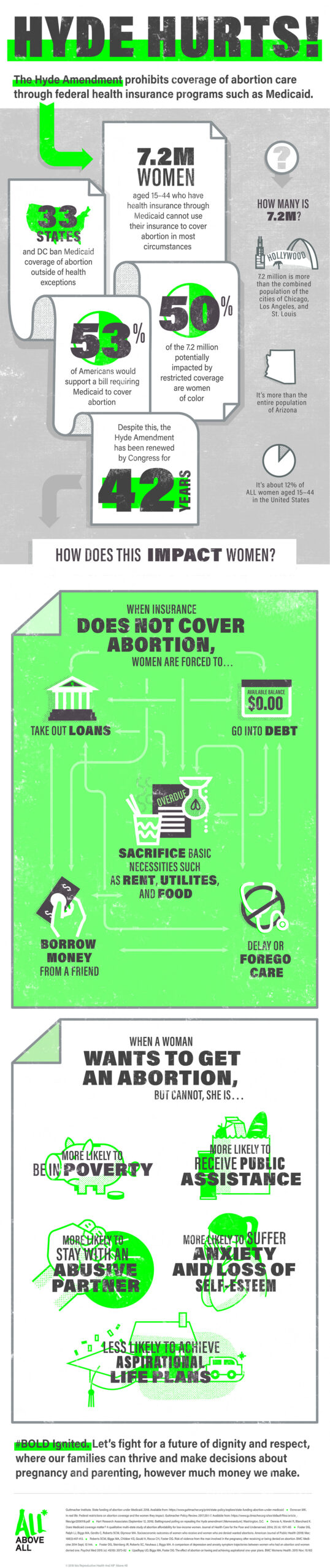
Five Ways Hyde Hurts

Let’s fight for a future of dignity and respect, where our families can thrive and make decisions about pregnancy and parenting, however much money we make.

hyde hurts

In Our Own Voice: One Fair Wage Editorial

Editorial in The Washington Informer by Heidi Williamson, In Our Own Voice’s Deputy Director of Strategic Partnerships

Durham County Board of Commissoners Resolution

On April 9, 2018, the Durham County Board of Commissioners unanimously passed a resolution calling for an end to the Hyde Amendment and calling upon President Trump and North Carolina Governor Roy Cooper to support measures to ensure and protect the rights of women, transgender, and gender-nonconforming individuals everywhere to have unhindered access to safe and comprehensive health care.

Economic Opportunity and Reproductive Health Polling Memo-October 2017

This memo summarizes the key findings from a telephone survey among 1,101 adults who voted in the 2016 presidential election, including oversamples of African-American voters (total of 185), Hispanic voters (total of 170), and Asian-American voters (total of 116).  The interviews were conducted from October 4 to 10, 2017. The sample is representative of the 2016 electorate demographically and politically, including of the 2016 presidential vote.

Información en español sobre la EACH Woman Act

EACH WOMAN ACT: El Proyecto de Ley de Acceso a la Cobertura de Aborto Para Cada Mujer en Seguros de Salud (EACH Woman Act por su nombre en inglés)

TEMAS DE DISCUSIÓN

[Título] EACH Woman Act asegura que toda mujer pueda ejercer su derecho a planificar su propia familia.

[VISIÓN] Cuando se trata de las decisiones más importantes en la vida, tal como decidir ser madre, es importante que una mujer pueda considerar todas las opciones, independientemente de cuánto dinero gane o cuál es su seguro de salud. 

  • Cada mujer debe tomar sus propias decisiones. Ella consulta con sus seres queridos. Y lo más importante es que los políticos no se metan en las decisiones privadas de cada mujer.
  • No siempre conocemos las circunstancias de una mujer. Toda mujer quiere proveer para su familia y quiere lo mejor para su familia. Sin embargo hay veces que una mujer enfrenta circunstancias económicas difíciles. Este proyecto de ley asegura que no importa que tipo de seguro o que cantidad de dinero ella tenga, ella puede tener un aborto si ella decide interrumpir su embarazo.
  • Circunstancias económicas no deberían ser barreras–toda mujer tiene el derecho a planificar su familia.

[PROBLEMA] Durante mucho tiempo, los políticos han interferido en las decisiones médicas de las mujeres. Los políticos deciden cuales servicios médicos forman parte de un plan de seguro y, para muchas mujeres, servicios de aborto no forman parte de su plan de salud.  

  • Cada persona tiene sus propios sentimientos acerca del aborto. Sin embargo, los políticos no deberían negar que este servicio sea parte de un plan de salud.
  • Para muchas mujeres de bajos recursos, la falta de un plan de salud amplio es injusto. Una mujer que ha decidido interrumpir su embarazo tiene el derecho de obtener servicios de aborto, aunque ella no lo pueda pagar con seguro privado.
  • Cuando los políticos eliminan fondos gubernamentales para el cuidado de salud reproductivo, les hacen mas daño a mujeres de bajo ingreso, mujeres de color, inmigrantes, y mujeres jóvenes.

[SOLUCIÓN] Este proyecto de ley es un cambio importante para las mujeres y sus familias, creando dos normas importantes para la salud reproductiva:

  • Primero, respeta que todas las mujeres puedan tomar sus propias decisiones sobre el embarazo. Si una mujer recibe su seguro a través del gobierno federal, estará cubierta para recibir toda la atención relacionada con el embarazo, incluyendo el aborto.
  • Segundo, prohíbe la interferencia política en las decisiones de compañías privadas de seguro de salud y permite los servicios de aborto. Los legisladores locales, estatales y federales no podrán interferir con el mercado del seguro privado para prevenir que compañías de seguro ofrezcan la cobertura del aborto.

[SOLUCIÓN] El proyecto de ley asegura la cobertura del aborto para todas las mujeres, independientemente de cuánto gane, cómo está asegurada, o dónde vive.

  • Ya sea que tenga seguro de salud privado o financiado por el gobierno, todas las mujeres deberían tener un plan de salud amplio y con todo servicio relacionado al embarazo, incluyendo servicios de aborto.
  • Este proyecto de ley tiene sentido común: Cuando los programas de salud para mujeres con bajo ingreso cubran los anticonceptivos y el aborto, no solamente el parto, y las personas pueden planificar si quieren y cuándo tener hijos, es beneficioso para ellas y para toda la sociedad.

EACH-Woman-Act-Talking-Points-Spanish_070215

Abortion Coverage Bans On Public and Private Insurance: Access to Abortion Care Limited For Millions of Women

Health insurance is intended to help people cover both preventive and unexpected health costs. Yet federal and state politicians have singled out abortion and placed numerous bans on coverage for this health service within government-sponsored and private health insurance plans. Restrictions on insurance for abortion can have negative impacts for millions of women, especially low-income women, including higher out-of-pocket costs, increased stress, delays in accessing abortion care, or the inability to access abortion care altogether.